
Why Ranking Content Fails AI Retrieval






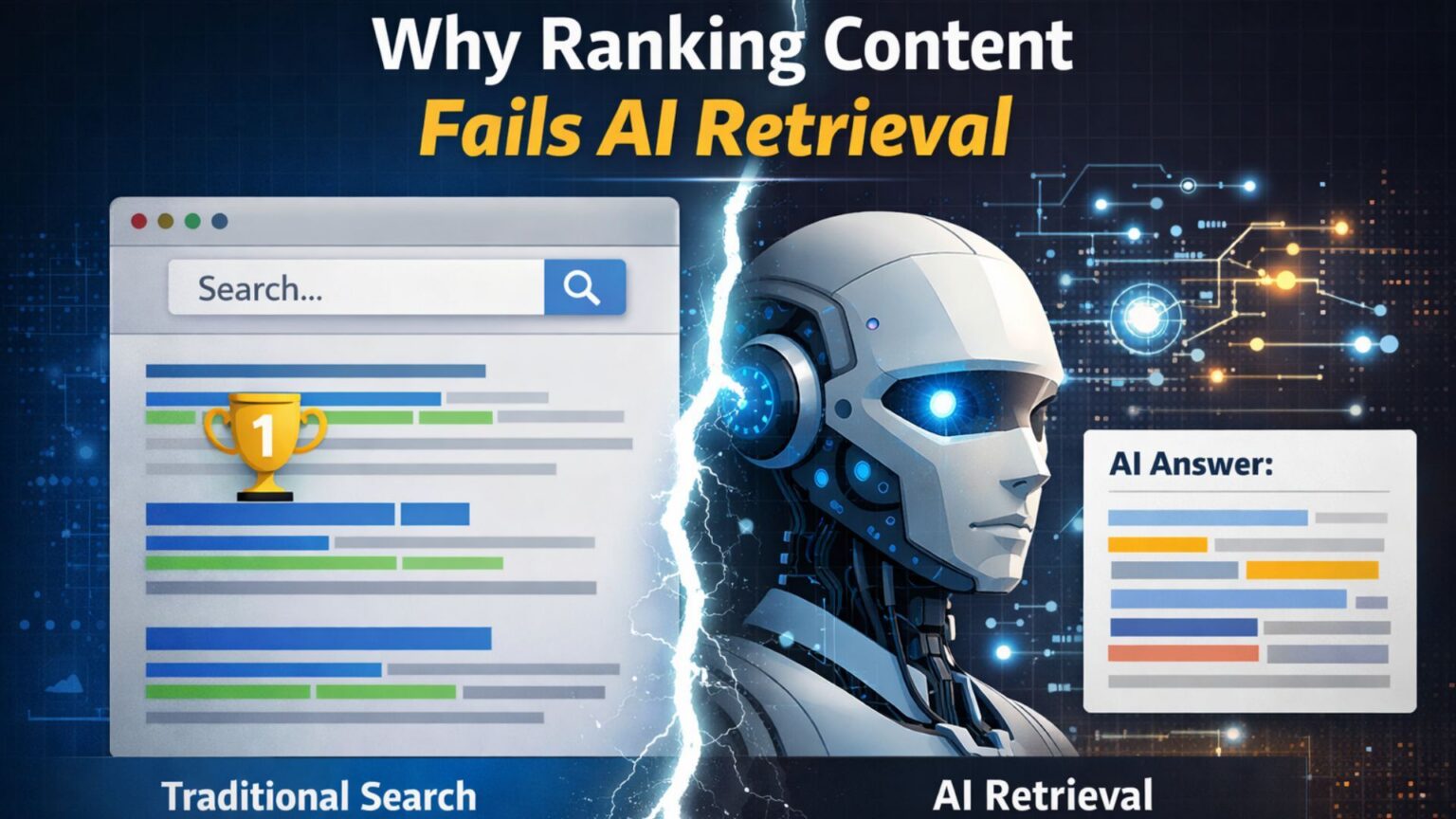
For years, content success was measured by one clear benchmark search engine rankings. If a page appeared on the first page of results, it was considered effective. Content strategies were built around keyword targeting, authority building, and technical optimization to secure those positions.
That approach is now incomplete.
Search behavior is evolving. Instead of only showing links, modern systems increasingly generate direct answers. These answers are formed by extracting and synthesizing information from multiple sources. As a result, visibility is no longer limited to ranking—it depends on whether content can be retrieved, interpreted, and reused.
This shift introduces a critical challenge: content that ranks well may still fail to appear in generated answers. This disconnect is known as the visibility gap.
The issue is rarely about quality or authority. In most cases, it comes down to structure, clarity, and how well content can be processed by retrieval systems.
This article explains why this gap exists and outlines practical ways to ensure content is not only indexed but also extracted and cited.
The Core Difference: Ranking vs Retrieval
Understanding the visibility gap begins with recognizing how traditional ranking differs from AI-driven retrieval.
Traditional Ranking: Page-Level Evaluation
Search systems historically evaluate entire pages. They analyze signals such as authority, relevance, backlinks, and historical performance to determine which page best matches a query.
Even if the exact answer is buried within the content, a strong page can still rank well because overall quality outweighs structural issues.
AI Retrieval: Fragment-Level Selection
Retrieval systems work differently. Instead of selecting full pages, they extract specific pieces of information.
This process typically involves:
- Parsing raw HTML
- Segmenting content into smaller units
- Converting text into semantic representations
- Matching these representations to user queries
The system then selects the most relevant fragments and uses them to generate an answer.
This means visibility depends on whether individual sections of content can stand alone and clearly communicate meaning.
A page may rank due to authority, but if its key insights are difficult to isolate, it will not be selected for retrieval.
Structural Failure 1: Content Is Not Accessible
The most fundamental issue occurs when content cannot be accessed properly.
Limited Processing of Dynamic Content
Many websites rely on client-side rendering, where content loads after the initial page response. While traditional search engines can process this over time, retrieval systems often prioritize speed and efficiency.
They may only analyze the initial HTML response.
If essential content appears only after scripts execute, it may not be visible to these systems.
Impact of Complex Markup
Even when content is present, excessive markup can reduce clarity. Deeply nested elements, heavy scripting, and unnecessary code create noise.
This affects how content is segmented and understood. The more complex the structure, the harder it becomes to isolate meaningful text.
How to Improve Accessibility
- Ensure key content appears in the initial HTML response
- Use pre-rendering or server-side rendering when possible
- Minimize unnecessary code around important text
- Maintain clean and readable markup
Accessibility is the foundation of retrieval. If content cannot be clearly seen, it cannot be used.
Structural Failure 2: Over-Reliance on Keywords Instead of Entities
Traditional optimization focuses on keywords. Retrieval systems focus on entities and relationships.
Keywords vs Entities
Keywords represent search phrases. Entities represent actual concepts, such as ideas, processes, or objects.
Content that relies heavily on generic wording may rank for keywords but fail to provide clear conceptual meaning.
For example, vague phrases like “effective methods” or “important strategies” do not define specific ideas. This weakens semantic clarity.
Why Entity Clarity Matters
Retrieval systems need precise meaning. They rely on clearly defined concepts to match content with queries.
When entities are not explicitly stated, the system cannot confidently extract information.
How to Strengthen Entity Signals
- Use precise terminology for concepts and processes
- Define key terms clearly within the content
- Maintain consistency in naming
- Avoid vague or generic language
Clarity improves semantic representation, which directly impacts retrieval success.
Structural Failure 3: Content Is Not Modular
Many high-quality articles follow a narrative structure. While this works well for human readers, it creates challenges for retrieval systems.
The Problem with Sequential Writing
Traditional writing builds context gradually. The main idea may appear after several sentences or paragraphs.
For retrieval systems, this reduces clarity. Important information becomes diluted within surrounding text.
The Need for Modular Content
Each section should function independently. A paragraph should deliver a complete idea without relying on external context.
Key Principles of Modular Design
1. Lead with the Answer
Start each section with a clear statement or definition. Supporting details should follow.
2. Focus on One Idea per Section
Avoid combining multiple concepts in a single block. This ensures clarity and stronger semantic signals.
3. Use Descriptive Headings
Headings should clearly reflect the content of the section. Avoid vague or creative phrasing that reduces clarity.
Benefits of Modular Structure
- Improves extractability
- Enhances clarity in isolated contexts
- Increases likelihood of being selected for retrieval
Content that can stand alone is more likely to be used.
Structural Failure 4: Inconsistent Signals Across Content
Even well-structured content can fail if signals are inconsistent.
Duplication and Variation
When similar content appears across multiple pages with slight differences, it creates ambiguity.
Instead of reinforcing one strong signal, the system generates multiple weaker interpretations.
This reduces confidence in selecting any one version.
Inconsistency in Metadata
Variations in titles, descriptions, and terminology create confusion about which version is authoritative.
Entity Inconsistency
Differences in how key terms are used across content weaken the overall representation of those entities.
How to Maintain Consistency
- Standardize terminology across all content
- Avoid unnecessary duplication
- Align metadata with content intent
- Ensure consistency in key definitions
Consistency strengthens semantic signals and improves retrieval confidence.
Beyond Structure: The Role of Information Value
Structure determines whether content can be retrieved. Information value determines whether it will be selected.
The Problem with Repetitive Content
Content that repeats commonly available information offers limited value. Retrieval systems prioritize content that adds something new.
If multiple sources provide similar answers, the system will favor the clearest or most distinctive one.
Why Unique Information Matters
Original insights create stronger signals. They provide a reason for the system to select a specific source.
Ways to Increase Information Value
1. Provide Original Data
Include unique statistics, research findings, or analysis. This creates distinct content that cannot be easily replicated.
2. Share Practical Insights
Explain real-world applications, challenges, or observations. This adds depth beyond general information.
3. Focus on Specific Topics
Narrow topics allow for deeper analysis and clearer positioning.
Long-Term Impact
Content with unique value remains relevant over time. It is less likely to be replaced by synthesized summaries.
Aligning Content Strategy with Retrieval Systems
To bridge the visibility gap, content must be optimized for both ranking and retrieval.
Optimize for Ranking
- Build topical authority
- Ensure relevance to search queries
- Maintain strong technical performance
- Create comprehensive coverage
This ensures content is indexed and discoverable.
Optimize for Retrieval
- Structure content for clarity
- Use modular sections
- Ensure accessibility in HTML
- Define entities clearly
- Maintain consistency across pages
This ensures content is extractable and usable.
Practical Checklist for Closing the Visibility Gap
Technical Level
- Ensure content loads in initial HTML
- Reduce dependency on client-side rendering
- Maintain clean and simple markup
Content Level
- Use clear and direct language
- Define key concepts explicitly
- Structure content into standalone sections
Structural Level
- Use descriptive headings
- Place key information at the beginning of sections
- Avoid unnecessary complexity
Strategic Level
- Add unique insights or data
- Focus on clarity over volume
- Maintain consistency across content
The Future of Content Visibility
Search is moving toward direct answers rather than link-based navigation. This shift changes how visibility is earned.
Ranking remains important, but it is no longer sufficient.
Content must be:
- Accessible
- Structured
- Clear
- Unique
These qualities determine whether information can be retrieved and used.
Conclusion: Visibility Requires Dual Optimization
The visibility gap highlights a fundamental change in how content is evaluated.
Ranking ensures presence. Retrieval ensures usage.
To succeed, content must perform at both levels.
This requires a shift in strategy:
- From page-level optimization to fragment-level clarity
- From keyword focus to entity clarity
- From narrative structure to modular design
Content that meets these requirements is more likely to be extracted, cited, and reused.
In an environment where answers are generated rather than linked, visibility depends on more than position.
It depends on structure, clarity, and the ability to communicate meaning independently.
Related Posts

Universal App Campaigns: Setup, Goals & Best Practices
Universal app campaigns allow you to find new users for your mobile apps. Now known as Google app campaigns, it is essentially a paid advertising...

アプリストア最適化のトップ企業
App Store Optimization(ASO)は、アプリが数百万のアプリの中で目立つための最も効果的な方法の一つです。さまざまなASO戦略を実施することで、アプリの可視性とコンバージョン率を向上させることができます。では、ASOの仕組みと、インドのトップ企業について理解し、ASOの進捗を加速する方法を見ていきましょう。 ASOの重要性 アプリストア最適化(ASO)は、アプリのオーガニックインストールを取得するための最良の方法です。ASOは、アプリのタイトル、説明、動画、スクリーンショット、ユーザーのレビューや評価を促進することなど、アプリストアの複数の側面に焦点を当てて、ランキングを向上させます。これが、ASOがアプリストアSEOとも呼ばれる理由です。 ASOの最適化により、アプリのクリック率(CTR)を向上させ、最初から高い顧客関係を築くことができます。ですので、アプリ開発者やマーケティング担当者であれば、アプリ最適化戦略を活用することで厳しい市場競争に立ち向かうことができます。 ASOとSEOの違いは? ASO(アプリストア最適化)とSEO(検索エンジン最適化)には似たような特徴があります。共通点の一つは、キーワードとコンバージョンの最適化です。概念には似ている部分がありますが、異なる特徴もいくつかあります。 アプリストアは検索エンジンと密接に関連しており、どちらも検索結果でアプリを見つける手助けをします。これがASOとSEOの重なりの部分です。また、どちらも質の高いコンテンツと適切なインデックス作成を必要とします。ASOとSEOのもう一つの共通点は、オーガニック検索ランキングです。ウェブサイトやモバイルアプリを最適化する際には、これら両方を考慮する必要があります。 これらの二つの似た点を除けば、ASOとSEOを区別する要素もあります。ASOはモバイルアプリ向けに最適化されており、アプリタイトル、キーワード、ビジュアルなどの要素を最適化してアプリの可視性やダウンロード数を増加させることに重点を置いています。一方、SEOはウェブコンテンツ向けで、検索エンジンでの可視性を向上させるために、キーワードやバックリンクなどを最適化します。 ASOはどのように機能するか? ASOは継続的なプロセスであることを忘れないでください。アプリストアのさまざまな要素を研究し、テストし、反復して、どのバージョンが最も効果的かを特定する必要があります。これにより、最も効果的なバージョンを特定し、競争に遅れずについていくことができます。 関連するASO戦略を実施するためには、ユーザーの意図とその反応を理解する必要があります。これにより、どの戦略が効果的か、どの戦略が効果がないかを見極めるための方向性を得ることができます。これは、視覚要素に焦点を当てたり、アプリマーケティングのコピーを作成してユーザーを引き付けたり、維持したりすることが含まれます。 では、最も重要な質問はどうやってアプリストアのASOを実行するかですか?アプリストア最適化技術について学ぶか、さまざまな無料・有料のASOツールを活用するか、専門家に任せることができます。 アプリストア最適化会社は何をするのか? ASO企業は、アプリのランキング向上に役立つさまざまなアプリストア最適化サービスを提供します。彼らはアプリのランキングとダウンロードを監視し、アプリがユーザーにとってより可視性を持つように戦略的な手段を実施します。 ASOアプリ最適化機関は、アプリ開発者やマーケターにとって非常に有益です。彼らはターゲットキーワードを特定し、アプリのタイトルと説明を最適化し、スクリーンショットやビデオの改善、アイコンデザインの改善も行います。 彼らの主な目的は、ユーザー体験を向上させ、利益を上げる行動を促進することです。これらの会社はまた、アプリデータに基づいた洞察を提供し、競争の激しい市場でアプリを目立たせるために役立つアドバイスを提供します。 ASO企業を活用することで、カスタムツールや技術を使用する利点を得ることができます。キーワード調査と最適化ツールからA/Bテストツールなどまで、これらはASOプロセスを簡素化し、望ましい結果を達成するのに役立ちます。 トップアプリストア最適化企業 ASOを成功させるためには、アプリの変更をチェックして反復する忍耐力が必要です。これにより、アプリのランキングを向上させるための正しい要素を特定することができます。ASOは継続的なプロセスであるため、すべてを一人で処理するのは複雑になることがあります。そこで、ASO企業が登場し、アプリストアの改善を支援してくれます。 ここではいくつかのトップASO企業を紹介します: NextGrowth Labsは、アプリのキーワードランキングやカテゴリーの向上、競合分析、コンバージョン最適化をサポートするインドの理想的なアプリストア最適化企業です。また、A/Bテストやアプリ分析など、さまざまな重要な機能も提供しています。 この会社の最大の利点の一つは、無料のASO分析を提供し、業界のベンチマークを超えるキャンペーンを実行することです。さらに、会社はアプリストア最適化のためのさまざまな無料ツール(キーワード追跡ツール、検索&アプリランキング追跡ツール、ASO&SEOコンテンツ支援ツールなど)も提供しています。彼らはアプリを慎重に分析し、インストール数、ランキング、コンバージョンを改善するための有益なアドバイスを提供します。...

A Complete App Store Optimization Checklist
The mobile app store market is significantly competitive with thousands of new apps being released every month. Your app can only reach the intended audience...