
The Essential Guide to Content Writing: From Concept to Conversion






In today’s digital-first economy, attention is limited, competition is intense, and clarity determines success. Businesses, creators, educators, and professionals rely on written communication to inform, influence, and inspire action. That is where content writing plays a critical role.
If you have ever searched online for answers, compared services, read a blog post, or downloaded a guide, you have experienced the impact of structured digital content. But what is content writing beyond a simple definition? How does it influence trust, authority, and revenue? And what does a content writer do to transform ideas into measurable outcomes?
This comprehensive guide explains content writing from concept to conversion, covering strategy, structure, SEO integration, and practical execution across 2000 words of in-depth insight.
Understanding the Core: What is Content Writing?
At its foundation, content writing is the strategic process of planning, creating, editing, and publishing written material for digital platforms. Unlike casual writing, it is purpose-driven. Every word supports a defined objective.
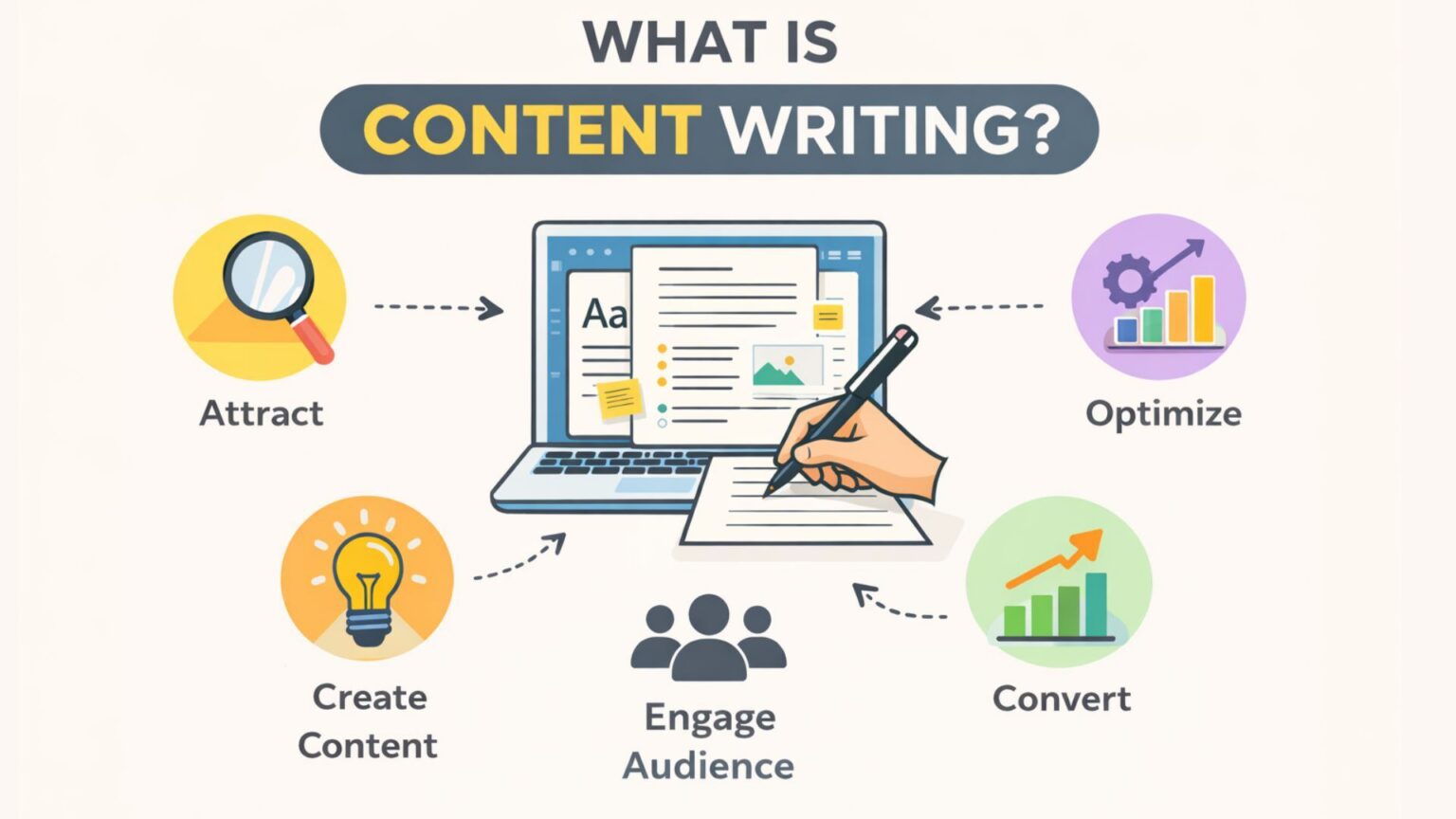
To fully understand what content writing is, consider its three core goals:
- Attract the right audience through search engines and digital channels.
- Engage readers with relevant, structured, and clear information.
- Convert readers into subscribers, leads, or customers.
Content writing is not a random expression. It is guided communication aligned with business intent.
Content Writing vs. General Writing
Many people confuse content writing with general writing. The difference lies in purpose and performance.
- General writing focuses on expression.
- Content writing focuses on measurable results.
- It incorporates audience psychology.
- It aligns with search engine visibility.
- It supports marketing funnels.
When someone asks, what is content writing, the most accurate answer is this: it is writing designed to achieve strategic digital outcomes.
The Role of the Article Writer: Crafting Authority Through Depth
Within content writing, one specialized role stands out — the article writer.
What is Article Writing?
What is article writing in digital marketing? It is the creation of structured, long-form informational content that answers a specific topic comprehensively.
Article writing typically involves:
- 1,000 to 3,000+ words
- Clear headings and subheadings
- Evidence-based explanations
- Logical flow and progression
- A defined introduction and conclusion
If someone searches what is a article writing, the correct interpretation is: it is a detailed written piece designed to educate, inform, and establish subject authority.
Why Article Writing Matters
Long-form articles:
- Build search engine authority
- Improve dwell time
- Capture high-intent queries
- Strengthen brand trust
- Support internal linking strategies
An article writer is responsible for depth, clarity, and completeness. Unlike short-form website copy, articles must sustain attention over thousands of words without losing relevance.
Distinguishing Article Writing from Other Content Formats
Not all content is an article. Understanding the distinction is critical.
1. Blog Articles
- Educational and informative
- Long-form
- SEO-focused
- Authority-building
2. Website Copy
- Persuasive
- Conversion-driven
- Short and direct
- Focused on action
3. Email Copy
- Personalized
- Relationship-focused
- Nurturing or promotional
4. Social Media Content
- Short-form
- Engagement-oriented
- Platform-specific tone
When analyzing what is article in writing, remember: it is structured informational prose designed to answer a topic completely in a standalone format.
SEO Content Writing: Where Strategy Meets Visibility
High-quality content alone is not enough. Discoverability determines impact.
What is a SEO Content Writer?
A SEO content writer is a professional who blends writing expertise with search engine strategy. They create content that:
- Ranks in search engines
- Matches user intent
- Uses keyword integration naturally
- Maintains readability
- Supports internal linking
In short, they write for both humans and algorithms.
Understanding Search Intent
Before writing, a content writer must identify the search intent behind a query. There are four main types:
- Informational – Users want knowledge.
- Navigational – Users seek a specific website.
- Transactional – Users intend to purchase.
- Commercial investigation – Users compare options.
Effective SEO content writing aligns the article structure with user intent.
Keyword Strategy Without Overuse
When discussing what is writing article content for SEO, keyword usage must be strategic and natural.
Types of Keywords
- Primary keyword – Main topic focus.
- Secondary keywords – Related variations.
- Semantic keywords – Contextual topic signals.
Proper keyword placement includes:
- Title
- H1 heading
- Introduction
- Subheadings (where relevant)
- Conclusion
- Meta description
However, forced repetition damages readability. Modern SEO prioritizes topic depth over keyword density.
What Does a Content Writer Do? A Practical Workflow
To understand the profession fully, we must answer: What does a content writer do daily?
The workflow typically includes:
1. Topic Research
This involves:
- Identifying audience pain points
- Validating search demand
- Reviewing competitor content
- Identifying content gaps
A content writer must ensure the topic has value before investing time in drafting.
2. Outline Creation
A structured outline prevents scattered writing. It defines:
- Main sections
- Supporting arguments
- Logical flow
- Headings hierarchy (H1, H2, H3)
Strong structure improves both user experience and search engine crawling.
3. Drafting the Content
Drafting includes:
- Writing clearly and concisely
- Maintaining tone consistency
- Using short paragraphs
- Adding examples where needed
- Ensuring logical transitions
Professional writing avoids unnecessary jargon while maintaining authority.
4. Editing and Optimization
After drafting, refinement begins:
- Grammar correction
- Clarity improvement
- Redundancy removal
- SEO alignment
- Readability formatting
Formatting includes:
- Bullet points
- Bold highlights
- Short paragraphs
- Subheadings
- White space for scannability
5. Performance Monitoring
Content writing does not end at publication. Monitoring includes:
- Organic traffic analysis
- Keyword ranking tracking
- Engagement metrics
- Conversion tracking
Optimization is continuous.
Building Content That Converts
Writing that informs but does not convert misses its business purpose.
Conversion-driven content includes:
- Clear calls to action
- Benefit-focused explanations
- Objection handling
- Trust signals
- Structured persuasion
The transition from concept to conversion happens when content moves readers from awareness to action.
Structuring Content for Maximum Impact
Online readers skim first and commit later. Structure determines readability.
Ideal Article Structure
- Compelling Introduction
- Clear Definitions
- Logical Section Progression
- Practical Examples
- Strategic Keyword Placement
- Summary and Call to Action
Writing an Effective Introduction
An introduction should:
- Address a real problem
- Define the topic clearly
- State what the reader will gain
- Establish authority
When defining what is content writing, clarity must appear immediately.
Depth Matters: The Power of Comprehensive Coverage
Search engines reward comprehensive content.
Covering variations like:
- what is content writing
- what is article writing
- what is article in writing
- what does a content writer do
- what is a SEO content writer
ensures topical completeness.
Comprehensive content:
- Reduces bounce rates
- Improves time on page
- Signals authority
- Answers related queries
- Supports semantic indexing
The Psychology Behind Effective Content Writing
Content writing is not just technical. It is psychological.
Effective content addresses:
- Pain points
- Aspirations
- Fears
- Objections
- Desired outcomes
It must:
- Build trust
- Offer clarity
- Reduce confusion
- Provide logical progression
Trust precedes conversion.
Practical Techniques for High-Performing Articles
To elevate article quality:
1. Use Active Voice
Clear, direct language improves readability.
2. Maintain Logical Flow
Each section should build upon the previous one.
3. Avoid Overcomplication
Clarity beats complexity.
4. Support Claims with Examples
Practical examples enhance understanding.
5. Prioritize Readability
Short sentences and structured formatting increase engagement.
Common Mistakes in Content Writing
Even experienced writers make errors.
Keyword Stuffing
Overuse reduces readability and harms rankings.
Weak Structure
Poor formatting increases bounce rates.
Lack of Audience Focus
Writing without understanding reader intent reduces impact.
Ignoring SEO Basics
No keyword research limits discoverability.
No Clear CTA
Without direction, readers leave without action.
Content Writing as a Career Path
Content writing offers multiple specializations:
- SEO content writing
- Technical writing
- Copywriting
- Long-form article writing
- Script writing
- Product description writing
Each specialization requires:
- Research skills
- Adaptability
- Industry awareness
- Audience understanding
The digital economy continues to increase demand for structured, search-optimized writing.
Measuring Content Success
Key performance indicators include:
- Organic traffic growth
- Keyword ranking improvements
- Time on page
- Bounce rate
- Conversion rate
- Backlinks acquired
Content writing success is measurable.
Future Trends in Content Writing
Digital content continues evolving.
Emerging trends include:
- AI-assisted research
- Semantic search optimization
- Voice search alignment
- Intent clustering
- Topical authority building
- Structured data integration
However, clarity and value remain timeless fundamentals.
From Concept to Conversion: The Final Framework
To summarize the full journey:
- Identify audience need.
- Validate search demand.
- Conduct competitive research.
- Create a structured outline.
- Draft clearly and strategically.
- Optimize for SEO.
- Edit for clarity.
- Publish with formatting.
- Monitor performance.
- Improve continuously.
This is the systematic approach that transforms raw ideas into revenue-driving digital assets.
Conclusion
Content writing is far more than arranging words on a page. It is a structured discipline that combines strategy, psychology, and search optimization to achieve defined business objectives.
Understanding what is content writing provides the foundation. Mastering what is article writing builds authority. Learning what does a content writer do clarifies the process. Recognizing what is a SEO content writer reveals the strategic advantage behind discoverable content.
When executed correctly, content writing becomes a powerful bridge between concept and conversion. It informs, builds trust, drives visibility, and ultimately turns readers into action-takers.
Related Posts

Universal App Campaigns: Setup, Goals & Best Practices
Universal app campaigns allow you to find new users for your mobile apps. Now known as Google app campaigns, it is essentially a paid advertising...

アプリストア最適化のトップ企業
App Store Optimization(ASO)は、アプリが数百万のアプリの中で目立つための最も効果的な方法の一つです。さまざまなASO戦略を実施することで、アプリの可視性とコンバージョン率を向上させることができます。では、ASOの仕組みと、インドのトップ企業について理解し、ASOの進捗を加速する方法を見ていきましょう。 ASOの重要性 アプリストア最適化(ASO)は、アプリのオーガニックインストールを取得するための最良の方法です。ASOは、アプリのタイトル、説明、動画、スクリーンショット、ユーザーのレビューや評価を促進することなど、アプリストアの複数の側面に焦点を当てて、ランキングを向上させます。これが、ASOがアプリストアSEOとも呼ばれる理由です。 ASOの最適化により、アプリのクリック率(CTR)を向上させ、最初から高い顧客関係を築くことができます。ですので、アプリ開発者やマーケティング担当者であれば、アプリ最適化戦略を活用することで厳しい市場競争に立ち向かうことができます。 ASOとSEOの違いは? ASO(アプリストア最適化)とSEO(検索エンジン最適化)には似たような特徴があります。共通点の一つは、キーワードとコンバージョンの最適化です。概念には似ている部分がありますが、異なる特徴もいくつかあります。 アプリストアは検索エンジンと密接に関連しており、どちらも検索結果でアプリを見つける手助けをします。これがASOとSEOの重なりの部分です。また、どちらも質の高いコンテンツと適切なインデックス作成を必要とします。ASOとSEOのもう一つの共通点は、オーガニック検索ランキングです。ウェブサイトやモバイルアプリを最適化する際には、これら両方を考慮する必要があります。 これらの二つの似た点を除けば、ASOとSEOを区別する要素もあります。ASOはモバイルアプリ向けに最適化されており、アプリタイトル、キーワード、ビジュアルなどの要素を最適化してアプリの可視性やダウンロード数を増加させることに重点を置いています。一方、SEOはウェブコンテンツ向けで、検索エンジンでの可視性を向上させるために、キーワードやバックリンクなどを最適化します。 ASOはどのように機能するか? ASOは継続的なプロセスであることを忘れないでください。アプリストアのさまざまな要素を研究し、テストし、反復して、どのバージョンが最も効果的かを特定する必要があります。これにより、最も効果的なバージョンを特定し、競争に遅れずについていくことができます。 関連するASO戦略を実施するためには、ユーザーの意図とその反応を理解する必要があります。これにより、どの戦略が効果的か、どの戦略が効果がないかを見極めるための方向性を得ることができます。これは、視覚要素に焦点を当てたり、アプリマーケティングのコピーを作成してユーザーを引き付けたり、維持したりすることが含まれます。 では、最も重要な質問はどうやってアプリストアのASOを実行するかですか?アプリストア最適化技術について学ぶか、さまざまな無料・有料のASOツールを活用するか、専門家に任せることができます。 アプリストア最適化会社は何をするのか? ASO企業は、アプリのランキング向上に役立つさまざまなアプリストア最適化サービスを提供します。彼らはアプリのランキングとダウンロードを監視し、アプリがユーザーにとってより可視性を持つように戦略的な手段を実施します。 ASOアプリ最適化機関は、アプリ開発者やマーケターにとって非常に有益です。彼らはターゲットキーワードを特定し、アプリのタイトルと説明を最適化し、スクリーンショットやビデオの改善、アイコンデザインの改善も行います。 彼らの主な目的は、ユーザー体験を向上させ、利益を上げる行動を促進することです。これらの会社はまた、アプリデータに基づいた洞察を提供し、競争の激しい市場でアプリを目立たせるために役立つアドバイスを提供します。 ASO企業を活用することで、カスタムツールや技術を使用する利点を得ることができます。キーワード調査と最適化ツールからA/Bテストツールなどまで、これらはASOプロセスを簡素化し、望ましい結果を達成するのに役立ちます。 トップアプリストア最適化企業 ASOを成功させるためには、アプリの変更をチェックして反復する忍耐力が必要です。これにより、アプリのランキングを向上させるための正しい要素を特定することができます。ASOは継続的なプロセスであるため、すべてを一人で処理するのは複雑になることがあります。そこで、ASO企業が登場し、アプリストアの改善を支援してくれます。 ここではいくつかのトップASO企業を紹介します: NextGrowth Labsは、アプリのキーワードランキングやカテゴリーの向上、競合分析、コンバージョン最適化をサポートするインドの理想的なアプリストア最適化企業です。また、A/Bテストやアプリ分析など、さまざまな重要な機能も提供しています。 この会社の最大の利点の一つは、無料のASO分析を提供し、業界のベンチマークを超えるキャンペーンを実行することです。さらに、会社はアプリストア最適化のためのさまざまな無料ツール(キーワード追跡ツール、検索&アプリランキング追跡ツール、ASO&SEOコンテンツ支援ツールなど)も提供しています。彼らはアプリを慎重に分析し、インストール数、ランキング、コンバージョンを改善するための有益なアドバイスを提供します。...

A Complete App Store Optimization Checklist
The mobile app store market is significantly competitive with thousands of new apps being released every month. Your app can only reach the intended audience...